
Continuous Filtration Cuts Water Loss, Energy Penalties, and Maintenance Burden in Steel Cooling
SANTA FE SPRINGS, Calif., April 30, 2026 /PRNewswire-±¬ÁϹ«Éçapp/ -- Steel production operates on continuous duty cycles where cooling systems, descaling lines, and recirculating water loops must perform without interruption. In these environments, suspended solids including mill scale, iron oxides, and fine particulates accumulate and recirculate, steadily degrading system performance and increasing operational risk.
Operators consistently identify fine particulate fouling as a primary constraint on cooling efficiency. As solids migrate through the system, they deposit in spray headers and nozzles, restricting flow and producing uneven cooling distribution. The result is reduced thermal consistency, elevated mechanical stress, and accelerated wear across pumps, valves, and heat exchange surfaces. Across typical operations, these effects can translate into an estimated $40,000 to $50,000 in annual impact per cooling loop when left unmitigated.
Filtration to the 10 micron range directly targets the particle sizes most responsible for clogging and fouling. Removing these particles upstream of critical components preserves spray integrity, stabilizes heat transfer performance, and reduces long term equipment degradation.
However, conventional filtration approaches introduce their own inefficiencies. Sand media systems depend on periodic backwashing, interrupting flow and discharging significant volumes of water. In a 10,000 GPM cooling loop, a single sand filter can release approximately 1,500 gallons per backwash cycle, exceeding 30,000 gallons per week per unit. This discharge must be replaced, treated, and managed, adding cost and operational complexity while increasing overall system water demand.
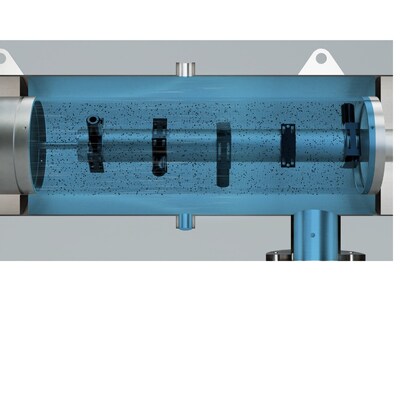
Tekleen automatic self-cleaning water filters provide an alternative approach by enabling continuous solids removal while maintaining uninterrupted flow during backwash. Each cleaning cycle uses approximately 50 gallons of water, reducing filtration-related discharge by up to 90 percent. By eliminating flow interruptions and minimizing water loss, these systems support stable operation under continuous production conditions.
The operational implications extend beyond water conservation. Facilities without continuous filtration typically require 50 to 70 hours of manual nozzle cleaning annually, representing labor costs between $12,000 and $18,000. With automatic self-cleaning filtration, maintenance requirements are reduced to approximately 10 to 20 hours per year, lowering labor costs to an estimated $2,000 to $4,000 while improving maintenance planning and system reliability.
Fouling also impacts energy performance. Accumulated solids reduce hydraulic efficiency, increasing pumping demand and introducing an estimated 2 to 5 percent energy penalty. This can equate to $10,000 to $15,000 in additional annual energy costs. Maintaining cleaner system conditions reduces this penalty substantially, lowering energy-related costs to approximately $2,000 to $4,000 per year.
Water and discharge management follow a similar pattern. Systems reliant on high-discharge filtration and manual intervention can incur $15,000 to $20,000 annually in water and wastewater handling costs. With reduced discharge volumes and continuous filtration, these costs can be reduced to approximately $3,000 to $5,000.
Taken together, these factors represent a measurable shift in total cost of ownership, with filtration performance influencing water usage, energy consumption, maintenance demand, and overall system stability.
Nagui Elyas, Chief Executive Officer of Tekleen Automatic Filters, LLC, stated, Steel facilities operate under conditions where even minor instability can have outsized consequences. Continuous removal of suspended solids, combined with uninterrupted flow during backwash, allows operators to maintain consistent cooling performance while materially reducing water loss and maintenance exposure.
Dan Flanick, Chief Revenue Officer of Tekleen Automatic Filters, LLC, added, Filtration should be evaluated as a system level control point. Water consumption, energy efficiency, maintenance load, and process stability are directly linked. Improving filtration performance improves the performance of the entire cooling system.
Continuous filtration also alters how facilities manage operations. Cooling performance becomes more predictable, maintenance transitions from reactive to planned, and exposure to unplanned interruptions is reduced. These characteristics are critical in steel environments where uptime, throughput, and process consistency directly influence production outcomes.
As steel producers continue to prioritize efficiency, resource optimization, and operational resilience, water filtration is increasingly being evaluated as a core component of system performance rather than a secondary utility. Technologies that enable fine particle removal, reduce discharge volumes, and maintain uninterrupted flow during backwash are emerging as key enablers of that shift.
About Tekleen
Tekleen Automatic Filters, LLC designs and manufactures automatic self-cleaning water filtration solutions for industrial, irrigation, and municipal applications. With more than four decades of engineering experience, Tekleen systems are engineered to deliver reliable performance, reduced water consumption, and uninterrupted flow in high-demand operating environments.
Media Contact
Hani Philobbos
Chief Marketing Officer
Tekleen Automatic Filters, LLC
Media Contact
Hani Philobbos, Tekleen, 1 9497676755, [email protected],
SOURCE Tekleen

Share this article